 May 16 2026
 May 09 2026
 May 02 2026
 Apr 25 2026
 Apr 18 2026
 Apr 11 2026
 Apr 04 2026
 Mar 28 2026
 Mar 21 2026
 Mar 14 2026
 Mar 07 2026
 Feb 28 2026
 Feb 21 2026
 Feb 14 2026
 Feb 07 2026
 Jan 31 2026
 Jan 24 2026
 Jan 17 2026
 Jan 10 2026
 Jan 03 2026
 Dec 27 2025
 13-26 December 2025
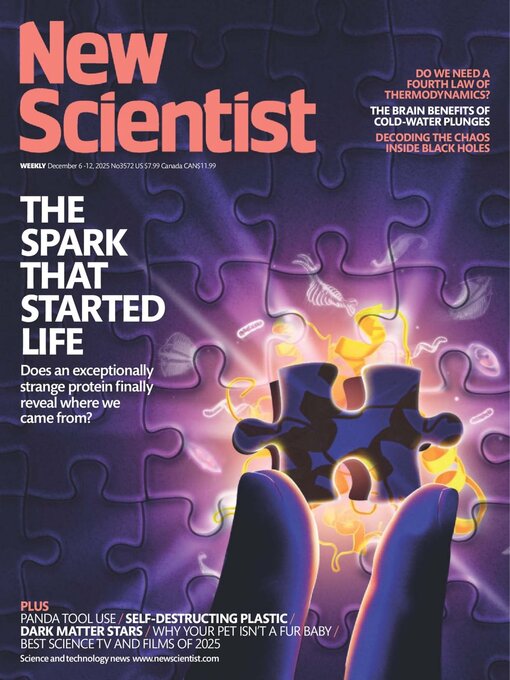
 Dec 06 2025
 Nov 29 2025
New Scientist covers the latest developments in science and technology that will impact your world. New Scientist employs and commissions the best writers in their fields from all over the world. Our editorial team provide cutting-edge news, award-winning features and reports, written in concise and clear language that puts discoveries and advances in the context of everyday life today and in the future.
Infection, anyone? • Human challenge trials have never been more popular
New Scientist
Counting elusive elephants
Pregnancy alters mouth bacteria • Dental problems often arise during pregnancy, and rapid changes to the oral microbiome could be partly to blame, finds Chris Simms
Our feline friends spread around the world later than expected
Plastic can be programmed to self-destruct
First hints of dark matter stars… • Huge stars powered by dark matter instead of nuclear fusion could solve several mysteries of the early universe, reports Leah Crane
… and of what dark matter itself is made of
Have we found a greener way to do deep-sea mining?
Droughts led to the collapse of the Indus Valley Civilisation
We may need a fourth law of thermodynamics
Ancient foot mystery may finally be solved
Africa’s forests have become a carbon source
Cats overcome fear of water to benefit from aquatic therapy
Chip sale may shake up the AI industry • Google is reportedly in talks to sell its custom computer chip designed for AI to other tech firms, a move that could unsettle the dominant chip-maker Nvidia, reports Alex Wilkins
Universal law for how objects shatter • Knowing how brittle objects fragment could improve mining and help prepare for rockfalls
False thumb allows pandas to use tools to scratch that itch
Monthly injection could replace daily steroids for asthma
Rapa Nui statues may have been built by small groups
Taxable crops led to the first states • How the first large-scale societies formed has long been debated, but the answer could lie in the farming of easily taxed plants like wheat and maize, finds Chris Simms
Your brain undergoes four dramatic periods of change from age 0 to 90
Deadly fungus makes sick frogs jump further
Who’s a good boy? • Our increasing tendency to treat pets as surrogate children, or “fur babies”, has dire consequences for these animals, warns Eddie Clutton
The neuroscience column • Diving in Researchers are finding that cold-water swimming may reshape our brains for the better in lasting ways, and could even protect against some age-related conditions, says Helen Thomson
Zooming in
The look of success • What were the best sci-fi shows of 2025? Andor and Severance are still up there, but Bethan Ackerley also has some unexpected tips to share
Humans and other animals • From animal rivals to Jane Goodall’s last thoughts, here’s Bethan Ackerley’s guide to 2025’s best science documentaries
In search of the soul of 2025 • It’s been an eclectic year of sci-fi films, and Simon Ings finds that while many of them retrod old ground, a few set themselves apart where it counts
Your letters
Unexpected origins • We have long puzzled over how life began. Now, evidence suggests a sinister protein may be the missing ingredient, says virologist Michel Brahic
Beyond the horizon • Unravelling what’s inside a black hole could reshape the foundations of how we think about space and time, finds Adam Mann
Would you make yourself sick for science? • People are willingly becoming infected with diseases in order to discover how our immune system fights back. What motivates them, asks David Adam
I think we’re alone now • We can feel lonely even when we’re surrounded...